PACT Couples Therapy
You didn't come this far in your relationship to feel this alone in it.
Maybe there's been a betrayal, something that shattered the trust you spent years building. Maybe one of you is carrying trauma that keeps showing up between you, in ways neither of you fully understands. Maybe there's no single dramatic thing you can point to, just a slow, painful drift, and the quiet fear that you've lost something you can't get back.
Whatever brought you here, I want you to know: the fact that you're still looking for a way through says something important about you.
I offer PACT couples therapy in Seattle for couples carrying some of the hardest things a relationship can hold, infidelity, relational trauma, chronic disconnection, the aftermath of abuse, the strain of one partner's mental health struggles on both of you. These aren't problems that respond to communication worksheets or a weekend retreat. They go deeper than that. And they deserve an approach that goes deeper, too.
PACT, the Psychobiological Approach to Couples Therapy, is that approach for me. It's the framework I return to again and again with couples because it doesn't just ask what you're fighting about. It asks what is happening inside each of you in the moments things fall apart. What your nervous systems learned about safety and closeness long before you ever met each other. How those histories show up now, in the most intimate moments of your relationship.
That's where the real work lives. And in my experience, it's where real healing becomes possible, even when things have felt broken for a long time.
What Is PACT Couples Therapy?
PACT couples therapy stands for the Psychobiological Approach to Couples Therapy. It was developed by Dr. Stan Tatkin, a clinician and researcher who spent years studying what actually happens between two people in an intimate relationship, at the level of the brain and nervous system.
What he found is that most couples aren't struggling because they lack communication skills or don't love each other enough. They're struggling because their nervous systems are stuck in patterns of protection, patterns that made sense at some point in their lives, but that now get in the way of the closeness they're both looking for.
PACT takes that seriously. It's not a passive, talk-it-through model. It's active, present-focused, and grounded in some of the most current research we have on how human beings connect, protect themselves, and heal.
The Three Pillars of PACT
PACT couples therapy draws on three bodies of research that, together, give us a fuller picture of what's really happening in a relationship:
Attachment Theory. Originally developed by John Bowlby, attachment theory tells us that we are wired from birth to seek safety and connection with others. The patterns we develop early, around trust, closeness, and what happens when we reach for someone and they're not there, don't disappear when we grow up. They come with us into our most intimate relationships, often without our awareness.
Arousal Regulation. This refers to how well each of us manages our internal emotional states, and how much we rely on our partner to help us do that. Some of us become overwhelmed quickly and need help coming back down. Others shut down and go distant. Understanding these patterns in yourself and your partner changes everything.
Neuroscience. Our brains are social organs. They are constantly reading the people around us for signals of safety or threat, and in an intimate relationship, no one's signals matter more than our partner's. PACT uses what we know about the brain to help couples understand why certain moments feel so activating, and how to build something more secure together.
Why Couples Get Stuck
Here is something I see again and again: two people who genuinely love each other, caught in a cycle neither of them chose and neither of them knows how to stop.
One person reaches out and the other pulls away. Or both escalate until someone says something they can't take back. Or the fight ends and nothing is resolved, just buried, until the next time. The topic changes. The pattern doesn't.
PACT couples therapy understands this not as a failure of love or character, but as a nervous system problem. When we feel threatened, even in ways that are subtle, even in ways we can't name, the parts of the brain responsible for empathy, reasoning, and connection go offline. We react. We protect. We do what we've always done when closeness felt dangerous.
In PACT, we think of a couple as a two-person psychological system. What that means, practically, is that each of you is constantly influencing the other's internal state, through tone of voice, facial expression, body language, timing. A moment of distraction can register as rejection. A well-meaning comment can land as criticism. And by the time the argument is in full swing, it often has very little to do with what it's supposed to be about.
Understanding this doesn't make the pain go away. But it does make it possible to do something different.
What PACT Sessions Look Like With Me
PACT couples therapy sessions are different from what most people expect when they think of couples therapy in Seattle.
Rather than spending the hour talking through what happened last week, we work in real time, with what is happening between you right now, in the room. I watch how you interact with each other. I pay attention to the moments of connection and the moments of rupture, the subtle shift in expression, the change in posture, the tone that lands differently than intended. When something important happens between you, we slow down and work with it right there, rather than letting it pass.
This kind of work can feel intense. It's meant to. Not because intensity is the goal, but because real change doesn't happen through insight alone. It happens through new experience, through learning, in your bodies and not just your minds, that it's possible to reach for each other in the hard moments instead of pulling away.
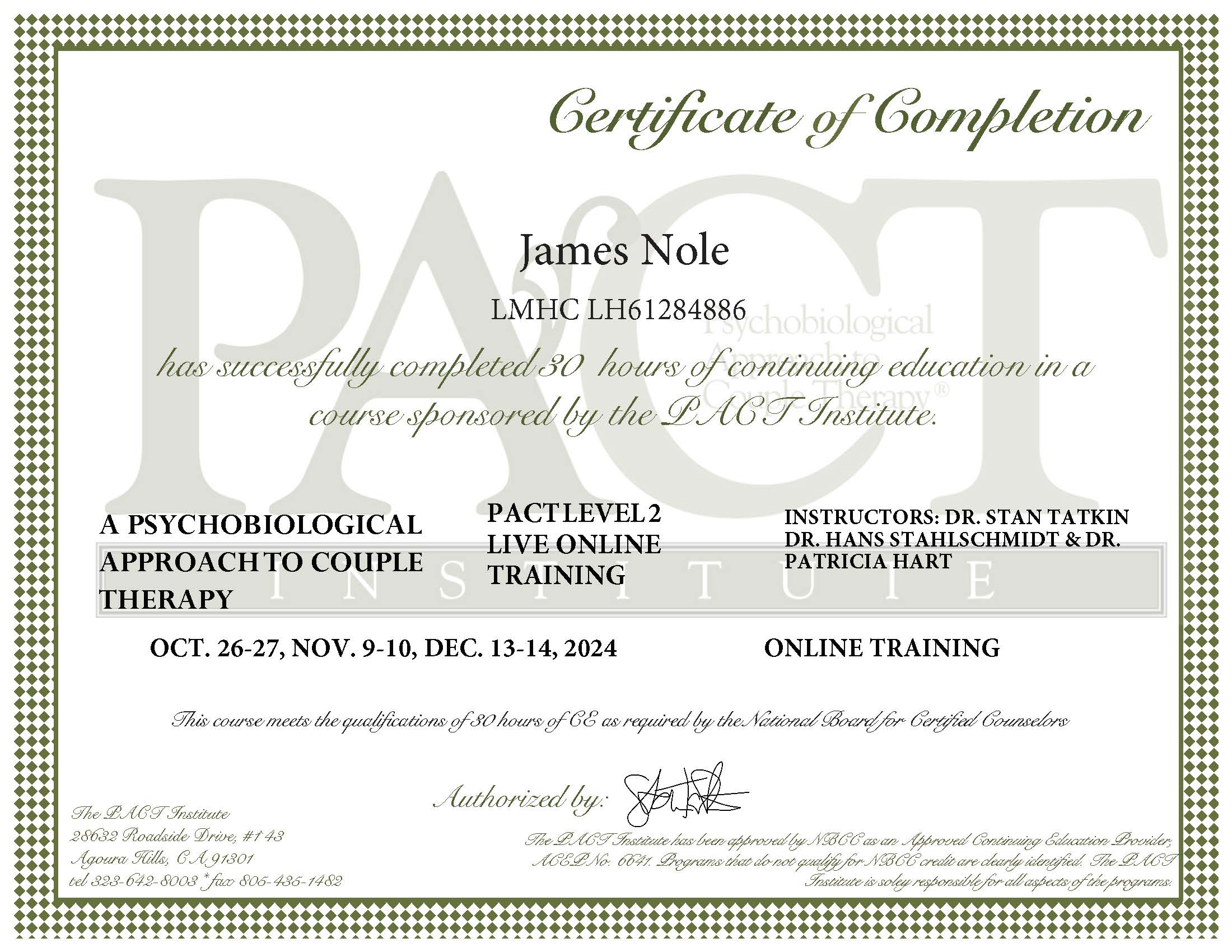
As a Level 2 trained PACT therapist in Seattle, I bring both clinical depth and genuine investment to this work. I also specialize in trauma and complex relational histories, which means that when the past shows up in your relationship (and it often does), I'm equipped to meet it with care.
Who Is PACT Couples Therapy For?
PACT couples therapy in Seattle can be helpful for couples at many different places in their relationship, from those navigating a specific crisis to those who simply feel like something has quietly slipped away and they don't know how to get it back.
It tends to be particularly well-suited for couples who have tried other approaches and found that something was still missing; couples where one or both partners carry a history of trauma, attachment wounds, or early experiences of loss or neglect; couples dealing with the aftermath of infidelity or broken trust; couples where one partner's mental health, depression, anxiety, or PTSD, has put real strain on the relationship; and couples who love each other but feel like they're speaking different languages.
You don't have to be in crisis to benefit from this work. But if you are in crisis, this approach can hold that too.
What Couples Experience Over Time
Progress in PACT couples therapy doesn't always look dramatic at first. It often shows up quietly, in a moment where one of you reaches for the other instead of withdrawing, and it works. In a conversation that used to end in shutdown or escalation, and this time doesn't. In a growing sense that your partner actually sees you, not the version of you they're reacting to, but you.
Over time, the couples I work with often describe feeling understood by their partner at a level they hadn't thought was possible; breaking free from conflict cycles that had repeated for years; a renewed sense of emotional safety, the feeling that the relationship is somewhere they can actually land; and finding their way back to closeness, even after a long stretch of distance or pain.
None of this happens overnight. But it does happen. And it tends to last, because the changes are happening at the level of the nervous system, not just the surface of behavior.
Why I Use PACT
What drew me to PACT couples therapy, and what keeps me returning to it, is that it takes the body seriously.
So much of traditional talk therapy asks people to think their way through their relational problems. And thinking matters. But thinking isn't always available in the moments when we need it most. When old wounds are live, when the nervous system is activated, when the argument is already in motion, the body is responding before the mind has caught up.
PACT works with that reality rather than around it. It meets couples where they actually are, not where they think they should be. And as someone who has done my own hard work of learning to live with difficulty, of understanding what it means to need others, and to let them in, I find that orientation deeply true.
I bring both my clinical training and my own lived experience to this work. I don't think those things are separate. And I believe that the kind of healing PACT makes possible is real, not because I read it in a textbook, but because I've seen it happen, again and again, in the room.
Frequently Asked Questions
How is PACT couples therapy different from other approaches?
Many couples therapy models focus primarily on communication, learning to express needs more clearly, listen more actively, fight more fairly. These are worthwhile goals. But PACT goes a level deeper, working with what's happening in the nervous system beneath the communication. It's particularly useful when communication skills alone haven't been enough.
What if only one of us wants to come to therapy?
It's very common for one partner to be more hesitant than the other. I make space for both perspectives in the room, including skepticism and uncertainty. You don't need to arrive fully convinced, just willing to show up and see what happens.
Is PACT couples therapy right for us if one partner has a trauma history?
Yes, and in fact PACT is particularly well-suited for couples where trauma is part of the picture. Because I also specialize in individual trauma work, I'm equipped to hold both the relational dynamics and the individual histories with care.
How long does PACT therapy typically take?
It depends on where you're starting from and what you're working toward. Some couples experience meaningful shifts within a few months. Others find it valuable to continue longer, especially when there's significant relational trauma or a long history of disconnection. We check in regularly on how things are going and what feels right for you.
Do you offer PACT couples therapy via telehealth in Washington State?
Yes. I offer both in-person PACT couples therapy sessions at my Pioneer Square office in Seattle and telehealth sessions for couples throughout Washington State.
What if we've already tried couples therapy in Seattle and it didn't help?
That's actually one of the most common things I hear. Many couples come to me after another approach didn't quite reach what was needed. PACT's focus on the nervous system and relational biology often gets at things that more conversation-based models miss. I'd encourage you to reach out and share what your experience has been, and we can talk about whether this might be different.
Closing
If something in what you've read here resonates, if you recognize yourself or your relationship in these words, I'd encourage you to reach out.
A free 30-minute consultation is a no-pressure way to share what's going on, ask questions, and get a sense of whether working together feels like a good fit. There's no obligation, and no need to have everything figured out before you call.
Who this helps: couples therapy in Seattle.
Related reading: PACT Couples Therapy in Seattle: A Psychobiological Approach to Lasting Connection.