DID and Dissociation Therapy in Seattle
At a glance: I offer therapy for DID and dissociative disorders at my Pioneer Square office in Seattle and by telehealth anywhere in Washington State. My work follows phased trauma treatment and draws on Deep Brain Reorienting and clinical hypnosis. Sessions are $205 for 50 minutes or $310 for 80 minutes, and the first 30-minute consultation is free.
There is a particular kind of loneliness that comes with dissociation. You lose time and cannot explain where it went. You sense parts of yourself that seem to have their own feelings, ages, and voices. You feel like a passenger in your own life, watching someone else take the wheel. And when you finally try to tell someone, you are too often met with disbelief.
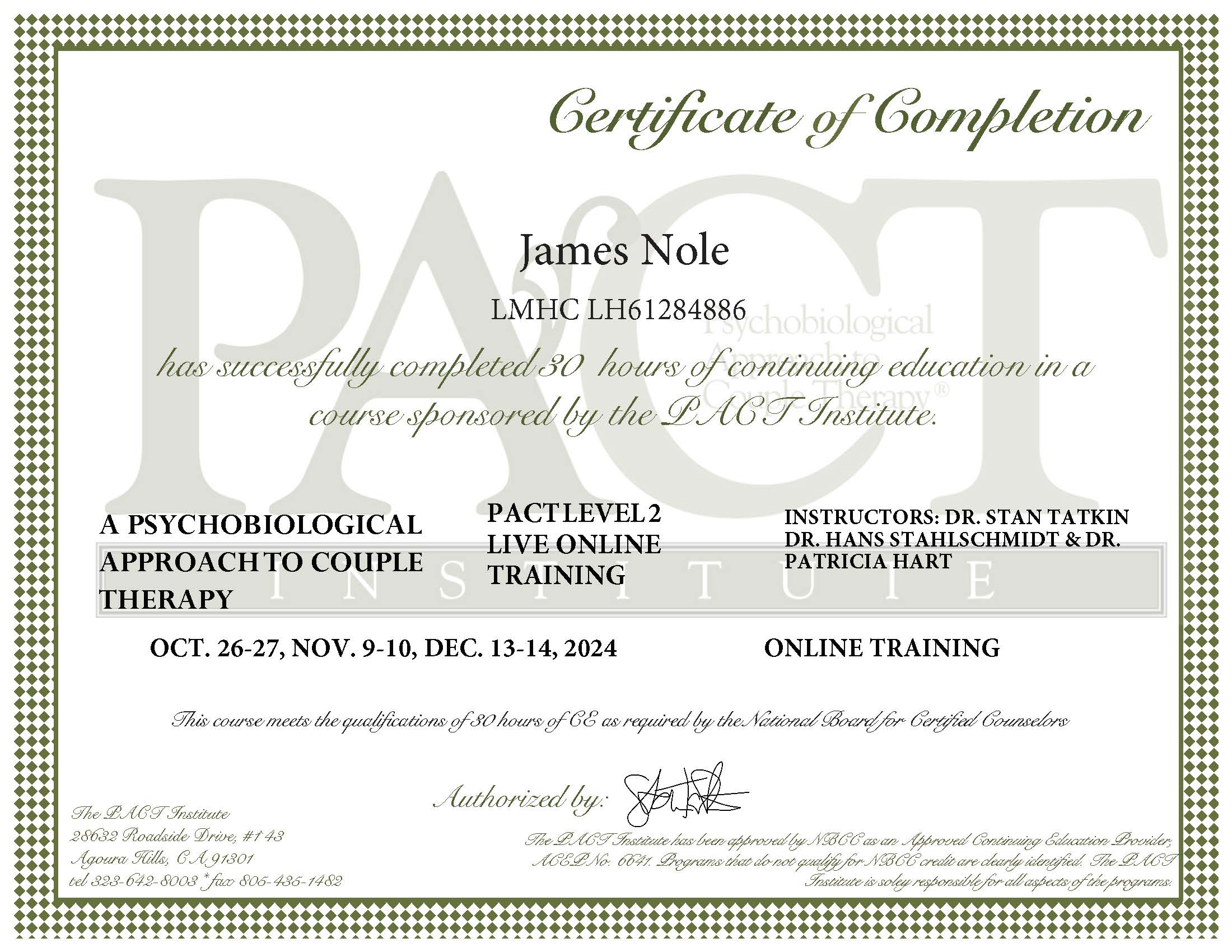
If this is your experience, you are not broken, and you are not making it up. I am James Nole, a licensed mental health counselor in Seattle, ISSTD-certified in complex trauma and dissociation. I work with people living with dissociation and Dissociative Identity Disorder (DID), and I take seriously what you tell me.
Dissociation is not a malfunction. It is one of the most remarkable things a mind can do. When a child faces something that cannot be survived whole, the mind finds a way to divide the unbearable so that life can go on. Those divisions helped you survive. In therapy, we honor that, even as we work toward a life where you no longer need to stay divided in the same way.
Schedule Your Free Consultation or call (206) 488-5543
As your therapist, I will focus on your needs. First, we will build safety and trust in our relationship. That will enable an open space for you to take risks, and together we can face wounds too painful for you to confront alone. You need someone to bear witness to your pain and struggles and walk alongside you on this journey.
I could be that person for you.
What Dissociation Can Feel Like
Dissociation is the mind’s way of protecting you from experiences that were too much to bear when they happened. It made sense then. But the same protection can make daily life confusing and frightening now. You might notice:
- Losing time, or finding gaps in your memory for hours, days, or whole stretches of childhood
- Feeling unreal, numb, or as if you are watching your life from outside your body
- Hearing internal voices, or sensing other parts of you with their own feelings, ages, or opinions
- Finding things you do not remember buying, writing, or doing
- Sudden shifts in mood, skills, preferences, or how you see yourself
- Being told about conversations or events you have no memory of
If any of this sounds familiar, you are not imagining it, and you are not alone.
How I Work With Dissociation and DID
I do not begin with a protocol. I begin by listening, to you and to every part of you that wants to be heard.
I am ISSTD-certified in complex trauma and dissociation, and my work follows the phased approach the field has found most helpful. We do not rush toward traumatic memories. We move at a pace your whole system can tolerate.
Safety and stabilization come first. Together we build ways to stay grounded, manage overwhelming states, improve communication inside, and make daily life feel more manageable. For many people, this phase alone brings real relief.
When there is enough stability, we can begin to process traumatic memories carefully and gradually, so that what was once unbearable can be held without flooding you. I often draw on Deep Brain Reorienting and clinical hypnosis in this phase, because they work gently at the level of the body and nervous system.
Over time, the work moves toward greater cooperation and connection among parts, and toward building a life that feels more like your own.
Every Part of You Is Welcome
I will not try to get rid of any part of you. Each part developed for a reason, usually to help you survive something that should never have happened. Parts that feel angry, frightened, young, or protective all have something important to say. My role is to listen to all of them with respect and curiosity, and to help them find ways of working together rather than against each other.
Many people with DID have been disbelieved, pathologized, or harmed by the very systems that were supposed to help them. I understand why trust may come slowly, and I will not ask you to trust me before you are ready.
Frequently Asked Questions
What is the difference between dissociation and DID?
Dissociation exists on a spectrum. Most people have mild dissociative experiences, like zoning out on a familiar drive. Dissociative Identity Disorder sits at the far end of that spectrum and involves distinct parts or identity states, along with gaps in memory. Many people fall somewhere in between, and I work with the full range.
Do I need a diagnosis to work with you?
No. Many people come to me unsure of what they are experiencing, or with a history of misdiagnosis. We can explore what is happening together, without pressure to fit a label.
Will we have to talk about my trauma right away?
No. We begin with safety, stabilization, and building trust. Trauma processing happens only when you and your system feel ready, and we will always go at a pace that does not overwhelm you.
What if a part of me does not want to be in therapy?
That is very common, and it makes sense. Parts that are wary of therapy are often trying to protect you. I welcome their concerns and take them seriously rather than trying to push past them.
Do you offer telehealth for dissociation and DID?
Yes. I see clients in person at my office in Pioneer Square, Seattle, and by telehealth throughout Washington State.
How do I know if we are a good fit?
A free 30-minute consultation is a no-pressure way to share what you are going through, ask questions, and get a sense of whether working together feels right.
Schedule Your Free Consultation or call (206) 488-5543
Approaches I use: Deep Brain Reorienting (DBR), clinical hypnosis.
Related reading: What Is Dissociation?; and An Introduction to Deep Brain Reorienting (DBR) Therapy.