Clinical Hypnosis
Most people have a picture in their mind of what hypnosis is. A swinging pocket watch. A stage performer. Someone clucking like a chicken on command.
That picture has almost nothing to do with clinical hypnosis. And the distance between that image and the reality is part of why so many people who could genuinely benefit from this work never find their way to it.
Clinical hypnosis is not about control, performance, or surrendering your will to someone else. It is a focused, collaborative, and evidence-based therapeutic approach that works with the deeper layers of the mind, the parts that ordinary conversation and conscious effort alone often cannot reach. It is used by licensed healthcare professionals around the world to treat trauma, depression, anxiety, chronic pain, and a wide range of conditions that have not responded fully to other approaches.
As a Registered Hypnotherapist in Washington State with ASCH Certification in Clinical Hypnosis, I bring rigorous clinical training and genuine investment to this work. For the right person, at the right moment in their healing, clinical hypnosis can reach something that nothing else has.
What Clinical Hypnosis Actually Is
Clinical hypnosis is a state of focused attention and heightened inner absorption, in which the ordinary chatter of the conscious mind quiets enough to allow access to deeper layers of thought, feeling, memory, and belief.
It is not sleep. You are aware throughout. You are not under anyone's control. You cannot be made to do or say anything against your will or your values. What hypnosis does is create a particular quality of attention, one that makes it possible to work with material that is ordinarily harder to access, the unconscious patterns, the embodied memories, the beliefs about yourself that formed long before you had language for them.
In a clinical context, this state is used purposefully and collaboratively. We decide together what we are working toward. The hypnotic state is a tool in service of your goals, not an end in itself.
The American Society of Clinical Hypnosis, founded by Milton H. Erickson in 1957 and the leading professional body for clinical hypnosis in North America, distinguishes clinical hypnosis sharply from stage hypnosis or lay hypnotherapy. ASCH certification requires that practitioners hold advanced degrees, state licensure, and undergo rigorous supervised training. It ensures that the person using hypnosis has the clinical judgment, diagnostic skills, and ethical grounding to use it responsibly.
What the Research Shows
Clinical hypnosis is not an alternative or fringe approach. It has been studied for decades, and the body of evidence supporting its use continues to grow.
Meta-analyses examining twenty years of research have found meaningful effectiveness for clinical hypnosis across a broad range of conditions, including chronic pain, depression, anxiety, trauma symptoms, and irritable bowel syndrome. Studies have found that combining hypnosis with other therapeutic approaches often produces stronger outcomes than either approach alone. Research has also demonstrated that hypnosis is as effective as cognitive behavioral therapy for depression in some populations, and that it has measurable effects on brain function and nervous system regulation.
The research base has grown substantial enough that clinical hypnosis has been granted Level I status as a nonhormonal treatment for menopause symptoms by the North American Menopause Society, the highest level of scientific evidence. Multiple major medical associations have endorsed its use.
This is not magic. It is science, applied through relationship, with care.
What Clinical Hypnosis Can Help With
In my practice, I use clinical hypnosis as an integrated part of therapy rather than a standalone technique. It tends to be most valuable for trauma and Complex PTSD, particularly when traumatic memories feel too overwhelming to approach directly, or when the body is holding what words have not been able to reach; depression and chronic low mood, where the deeper beliefs and patterns driving the depression can be accessed and worked with at a level below conscious reasoning; anxiety and fear responses that feel automatic and beyond voluntary control; chronic pain and somatic symptoms, where the mind-body connection is central to the experience and the healing; dissociative experiences, where hypnotic techniques can support stabilization, parts work, and careful integration; grief and loss, where the emotional processing has become stuck or frozen; and performance anxiety, creative blocks, and the internal barriers that keep people from accessing their full potential.
Clinical hypnosis is not appropriate for every person or every situation, and part of my role is to assess carefully whether and how to integrate it. We always discuss this together before proceeding.
What a Session With Clinical Hypnosis Looks Like
A session that incorporates clinical hypnosis begins the same way any good therapy session begins, with conversation. We talk about what you are working on, what you are hoping for, and any questions or concerns you have about the process. I take time to address the misconceptions that most people carry into the room, because a relaxed, informed, and willing participant is essential to the work.
The induction itself, the process of moving into a hypnotic state, is gentle and collaborative. It typically involves guided attention, focused breathing, and suggestions for deepening relaxation and inner focus. There is nothing dramatic about it. Many people describe the experience as feeling deeply relaxed but mentally alert, similar to the state just before sleep, or the absorbed quality of being completely lost in a piece of music or a book.
From there, the work varies depending on what we are addressing. We may explore imagery, work with memories or beliefs, rehearse new ways of responding to old triggers, or simply deepen the therapeutic processing that is already underway. Throughout, you remain in control. You can speak, shift, or end the session at any time.
When we bring the session to a close, we take time to reflect together on what arose and what it means. The hypnotic experience rarely stands alone. It is woven into the broader therapeutic work we are doing together.
My Training and Credentials
Clinical hypnosis is an area where credentials matter enormously, because the field is populated by practitioners whose training ranges from rigorous to minimal.
I am a Registered Hypnotherapist in Washington State and hold ASCH Certification in Clinical Hypnosis from the American Society of Clinical Hypnosis. ASCH Certification is a professional credential reserved for licensed, graduate-level clinicians who have completed approved training and supervised clinical experience in hypnosis.
Earning this certification required completing ASCH-approved Level 1 and Level 2 clinical hypnosis workshops, individualized consultation with an ASCH Approved Consultant, and independent clinical practice using hypnosis, in addition to my graduate training and state licensure as a mental health counselor.
I am also a member of ASCH, the largest interdisciplinary professional organization for clinical hypnosis in North America, founded by Milton H. Erickson in 1957. This membership situates my practice within an ongoing community of research, ethics, and peer accountability.
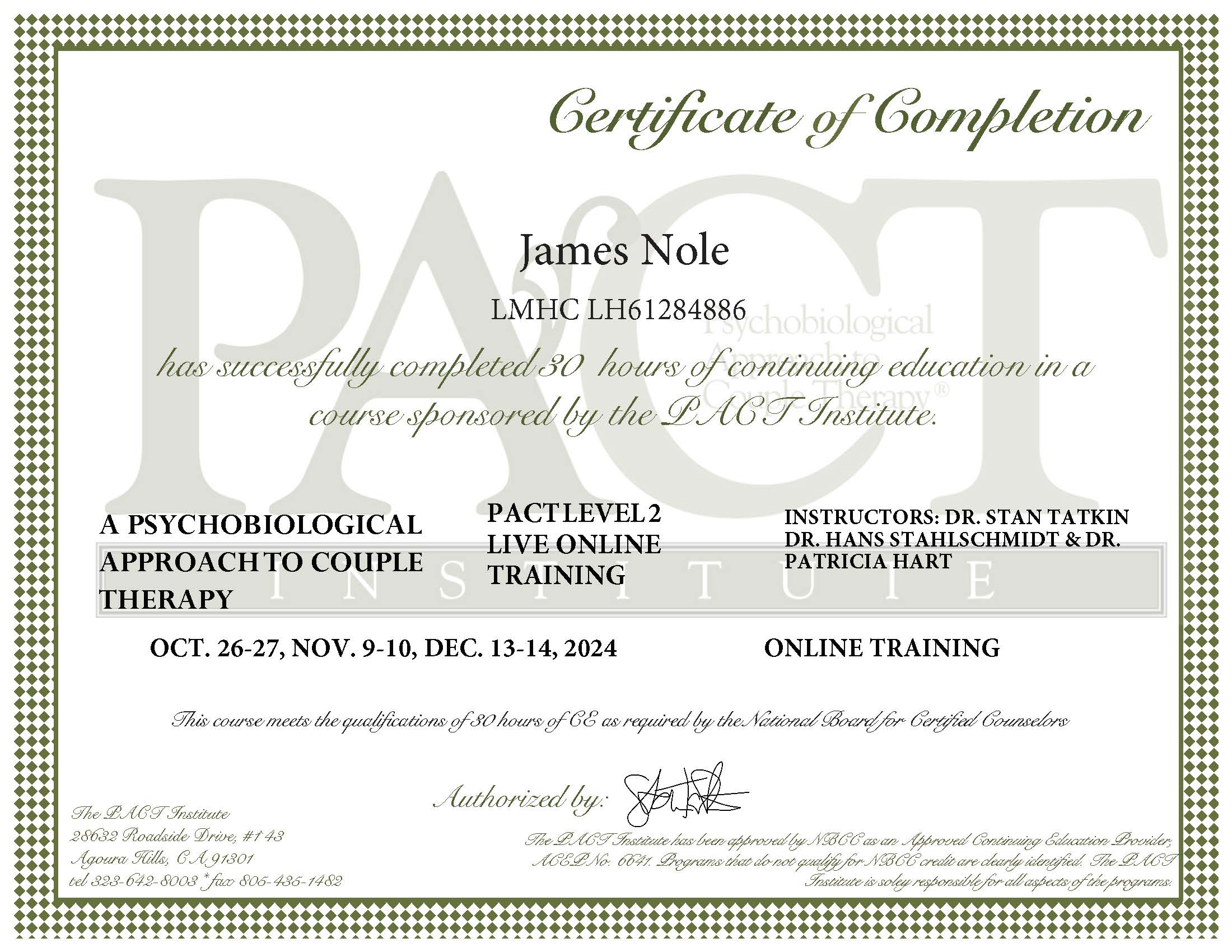
Clinical hypnosis is integrated into my broader practice alongside Relational Psychodynamic Therapy, PACT couples therapy, Deep Brain Reorienting, and trauma-specialized work. It is one tool among many, used thoughtfully and in service of each individual client's needs and goals.
Who This Approach Is For
Clinical hypnosis in Seattle may be particularly worth exploring if you have been in therapy and made progress, but feel that something remains stuck, something the talking alone hasn't reached; you carry trauma that feels lodged in the body rather than accessible through ordinary conversation; you struggle with chronic pain, somatic symptoms, or a mind-body disconnect that other approaches have not addressed; you experience anxiety, phobias, or fear responses that feel automatic and beyond your voluntary control; you are dealing with depression that feels deeper than circumstance, rooted in something older and less visible; or you are curious about working with the unconscious dimensions of your experience in a safe, boundaried, and clinically grounded way.
You do not need to believe in hypnosis for it to be useful. Openness and willingness are enough.
Why I Use Clinical Hypnosis
What drew me to clinical hypnosis is the same thing that draws me to all the approaches I practice: it takes seriously the parts of us that are not immediately visible.
So much of what shapes our lives happens beneath the surface of conscious awareness. The beliefs we formed before we had language. The ways our bodies learned to brace against pain. The emotional material that got frozen at moments of overwhelming experience, and never fully thawed. Talk therapy is essential and powerful. But it has a ceiling. And for some people, for some kinds of pain, that ceiling is reached before the deepest healing is done.
Clinical hypnosis, used well and within the context of a genuine therapeutic relationship, can go below that ceiling. Not by bypassing the person, but by creating the conditions in which deeper access becomes possible, safely, collaboratively, and with care.
I also bring my own lived experience to this work. I know what it is to be in a body that has faced profound loss, to search for healing in places where ordinary effort is not enough, and to be genuinely changed by the right kind of help at the right moment. That shapes how I hold this work, and how seriously I take the responsibility of it.
Frequently Asked Questions
Will I be in control during hypnosis?
Yes, completely. Hypnosis is a collaborative state, not one of surrender or loss of control. You remain aware throughout. You can speak, move, or end the session at any time. You cannot be made to do or say anything against your will or values. The popular image of hypnosis as a kind of mind control has no basis in clinical reality.
What does it feel like to be hypnotized?
Most people describe a state of deep relaxation combined with focused inner attention, similar to the feeling of being absorbed in a book, or the threshold state just before sleep. You are not unconscious. Many people are surprised by how natural and unremarkable the experience feels, especially compared to what they had imagined.
What if I can't be hypnotized?
Most people can enter a useful hypnotic state with proper guidance and a relaxed, willing mindset. Hypnotic responsiveness exists on a spectrum, and the degree of depth is not necessarily correlated with therapeutic benefit. We assess this together at the outset and adapt accordingly.
Is clinical hypnosis safe?
Yes, when practiced by a trained, licensed clinician. One of the reasons ASCH certification matters is precisely this: it ensures that the person using hypnosis has the clinical background to do so responsibly, within the context of a broader therapeutic relationship and sound ethical practice. I do not use hypnosis in isolation, and I take care to assess appropriateness on an individual basis.
How is clinical hypnosis different from what stage hypnotists do?
Stage hypnosis is performance. It selects highly suggestible volunteers and uses social pressure and entertainment dynamics to produce dramatic behaviors. Clinical hypnosis is a therapeutic tool used by licensed healthcare professionals, grounded in research, and oriented toward healing rather than spectacle. They share almost nothing in common beyond the name.
Can hypnosis be used alongside my other therapy work?
Yes. In my practice, clinical hypnosis is integrated into the broader therapeutic relationship rather than used as a separate or standalone service. It complements relational psychodynamic work, trauma processing, and other approaches we may be drawing on together.
Do you offer clinical hypnosis via telehealth?
Yes. Hypnotic work can be conducted effectively via telehealth, and I offer sessions for clients throughout Washington State in addition to in-person sessions at my Pioneer Square office in Seattle.
Closing
If you have been curious about clinical hypnosis, or if you have reached a point in your healing where you sense that something deeper is needed, I'd encourage you to reach out.
A free 30-minute consultation is a no-pressure opportunity to share what's going on, ask questions about this approach, and explore whether it might be a good fit for where you are right now.
Conditions I treat with this: trauma & C-PTSD therapy, therapy for DID & dissociation.
Related reading: Clinical Hypnosis: What It Is and What It Isn’t.