Anxiety Therapy in Seattle
Anxiety is trying to tell you something.
That is not how most people think about it. Most people experience anxiety as a problem to be solved, a noise to be quieted, a response to be managed so that life can continue as normally as possible. And there are plenty of approaches to therapy that will offer you exactly that: tools, strategies, breathing exercises, ways to interrupt the spiral before it takes hold. Those things are not without value. But for many people they are not enough. Because they treat anxiety as a malfunction rather than a message. They work on the surface of the experience rather than on what is driving it. And so the anxiety returns, in the same forms or in new ones, because whatever it has been trying to communicate has not yet been heard.
Anxiety, in my experience, is almost never random. It has roots. In the nervous system, in the body's oldest memories, in the relational history of the person carrying it, in the unconscious patterns that formed long before there were words for them, in parts of the self that have been disconnected or pushed aside, and in the existential questions that press in when the defenses are down. Understanding those roots is not a luxury for people who want to go deeper. For many people it is the only thing that actually works.
This is a different kind of anxiety therapy. Not faster. Not a set of tools to manage symptoms until the next time. But genuine, integrative, depth-oriented work that goes where the anxiety actually lives, and stays there long enough for something to genuinely change.
What Anxiety Actually Is
Anxiety is one of the most common human experiences and one of the most misunderstood.
At its most basic level, anxiety is the nervous system's response to perceived threat. It is the body mobilizing its resources, sharpening attention, preparing for danger. In that sense it is not a pathology. It is a survival mechanism, one that served human beings extraordinarily well for most of our evolutionary history, and that still serves an important function in genuine situations of threat or uncertainty.
But anxiety is also a form of communication. Every symptom, every wave of dread, every tightening in the chest or racing of the mind, is a symbolic expression attempting to tell us something. Something that has not yet found another way to be heard. Something that, if we can learn to listen to it rather than simply silence it, often points directly toward what most needs attention in a person's life.
In my understanding, rooted in systemic theory and ego state work, anxiety frequently originates at the moment a person becomes disconnected from a part of themselves. A part that carries a particular emotion, need, experience, or truth that the rest of the system has found too threatening or too painful to hold. That part does not disappear simply because it has been pushed aside. It communicates through the body. Through dreams. Through the anxiety that surfaces when the defenses are down or the circumstances of life press close to what that part is carrying.
Seen in this light, anxiety is not a malfunction. It is a voice. And the work of therapy is not to silence it but to learn what it is saying.
The Many Forms Anxiety Takes
Anxiety is not one thing. It wears many faces, and not all of them are immediately recognizable as anxiety.
It can be the obvious forms: the racing heart, the catastrophic thinking, the waves of dread that arrive without a clear cause, the physical tension that will not release, the hypervigilance that never fully rests.
It can also be the less obvious ones. The perfectionism that drives a person relentlessly and never allows them to feel like enough. The chronic busyness that functions as a way to never be still with what is underneath. The difficulty being present in relationships, the part of you that is always watching for the moment things go wrong. The sense of impending doom that sits at the edges of even genuinely good moments.
From a parts perspective, each of these expressions is worth understanding as its own communication. The perfectionism is not simply a bad habit. It is often a part carrying an old and deep belief about what is required to be safe or loved. The hypervigilance is not simply an overactive nervous system. It is often a part that learned, through real experience, that the world is not reliably safe, and that staying alert is the price of survival. The busyness is often a part protecting the system from feelings or truths that another part is not yet ready to face.
It can be the existential forms: anxiety about mortality, about meaning, about whether the life you are living is the one you actually want. The particular anxiety of freedom, the weight of knowing that your choices matter and that you cannot ultimately hand that responsibility to anyone else.
It can be the relational forms: the fear of abandonment that shapes how you attach to people, the anxiety about conflict that keeps you from saying what is true, the persistent sense that you are somehow too much or not enough for the people you want to be close to.
And it can be anxiety that is rooted in trauma, in the body's learned response to experiences of overwhelming fear or helplessness that never fully resolved. This kind of anxiety often does not respond to cognitive approaches because it is not primarily cognitive. It lives in the body, in the brainstem, in the nervous system's memory of what happened, and it requires approaches that work at that level to begin to shift.
Anxiety as a Message from a Disconnected Part
One of the most transformative shifts in understanding anxiety is moving from asking how do I make this stop to asking what is this trying to say, and who inside me is saying it.
Ego state theory and parts work offer a framework for understanding the inner life not as a single unified entity but as a system of parts, each carrying its own history, its own feelings, its own beliefs about the world and about what is required to be safe. In a well-functioning inner system, these parts are in communication with each other. They have access to the whole person's resources. They can be heard without taking over entirely.
Anxiety often arises when this internal communication breaks down. When a part carrying something important, fear, grief, shame, rage, an unmet need, an unacknowledged truth, has been cut off from the rest of the system and has no other way to make itself known. The anxiety is not the problem. It is the signal that something inside is asking to be heard.
This understanding changes the entire orientation of the therapeutic work. Rather than treating anxiety as an enemy to be defeated, we approach it with curiosity. What part of you is communicating through this symptom? What is it carrying? What does it need? What has it been trying to say, perhaps for years, that has not yet been adequately received?
In my experience, when a disconnected part is finally heard, when its message is genuinely received and the person is able to make contact with what it has been carrying, the anxiety often shifts in ways that no amount of symptom management has been able to produce. Not because the anxiety has been silenced, but because it no longer needs to shout.
The Roots of Anxiety
One of the things that makes anxiety so persistent is that its roots are almost always deeper than the symptoms suggest.
At the relational and psychodynamic level, anxiety is often rooted in early attachment experiences, in what was learned about safety, closeness, and what happens when you reach for someone and they are not there. A child who grew up in an environment of unpredictability, emotional unavailability, or threat learns to live in a state of vigilance. That vigilance does not disappear when the child becomes an adult. It becomes the background frequency of their nervous system, the lens through which they read every new relationship and every new situation.
At the somatic level, anxiety is often held in the body in ways that cognitive work alone cannot reach. The tension in the chest, the constriction in the throat, the hyperarousal that makes it hard to rest or be still, these are not just symptoms of anxiety. They are the body's memory of past experiences of threat, encoded at a level below conscious awareness.
At the systemic level, anxiety arises when the internal ecosystem of parts is out of balance, when certain parts have been exiled or silenced, and when the burden of carrying what those parts hold falls on the anxiety itself. Restoring communication between parts, giving each its due attention and its due hearing, is often the most direct path to lasting change.
At the existential level, anxiety is the natural response to the fundamental conditions of human existence: mortality, freedom, isolation, and the absence of prewritten meaning. These are not problems that can be solved. They are realities that have to be lived with, and learning to live with them honestly, without either collapsing into them or defending against them, is one of the most important tasks a human life contains.
Understanding which roots are most alive in a particular person's anxiety is the beginning of genuine therapeutic work. Not a one-size-fits-all treatment plan, but a careful, curious engagement with what this specific person is carrying and where it actually comes from.
A Different Approach to Anxiety Therapy
Most anxiety therapy in Seattle focuses on symptom management: identifying cognitive distortions, building coping skills, using mindfulness and breathing techniques to regulate the nervous system in the moment. These approaches have real value and I draw on elements of them where they are useful.
But they are not the foundation of how I work. And for many of the people who come to me, they have already tried those approaches and found that something remained untouched.
The foundation of my work with anxiety is integrative and depth-oriented. It draws on several bodies of knowledge and practice that together create a more complete picture of what anxiety is and where it lives.
From systemic theory and ego state and parts work, we approach each symptom as a symbolic communication from a part of the self that needs to be heard. We work to understand what is being communicated, to make contact with the part that is carrying it, and to restore the internal communication that allows the system to function with greater wholeness and ease.
From the relational psychodynamic tradition, we attend to the unconscious roots of anxiety, the early relational experiences that shaped the nervous system, the defenses that were built to manage unbearable feelings, the patterns that keep repeating because the original wound has never been adequately addressed.
From the existential and phenomenological tradition, we take seriously the meaning-level dimensions of anxiety, what it is pointing toward, what questions it is pressing on, what it reveals about how the person is living and what they most deeply need.
From Deep Brain Reorienting, we work at the brainstem level of the threat response, reaching the preaffective shock and orienting tension where anxiety is often most deeply anchored in the body, below the level of thought, below the level of emotion, in the oldest and deepest layers of the nervous system.
From clinical hypnosis, we access the deeper layers of the unconscious mind where anxious beliefs and patterns are most directly available to therapeutic work, in ways that ordinary conversation does not always reach. Hypnosis is particularly well suited to parts and ego state work, allowing direct communication with parts of the self that are not easily accessible through ordinary conscious reflection.
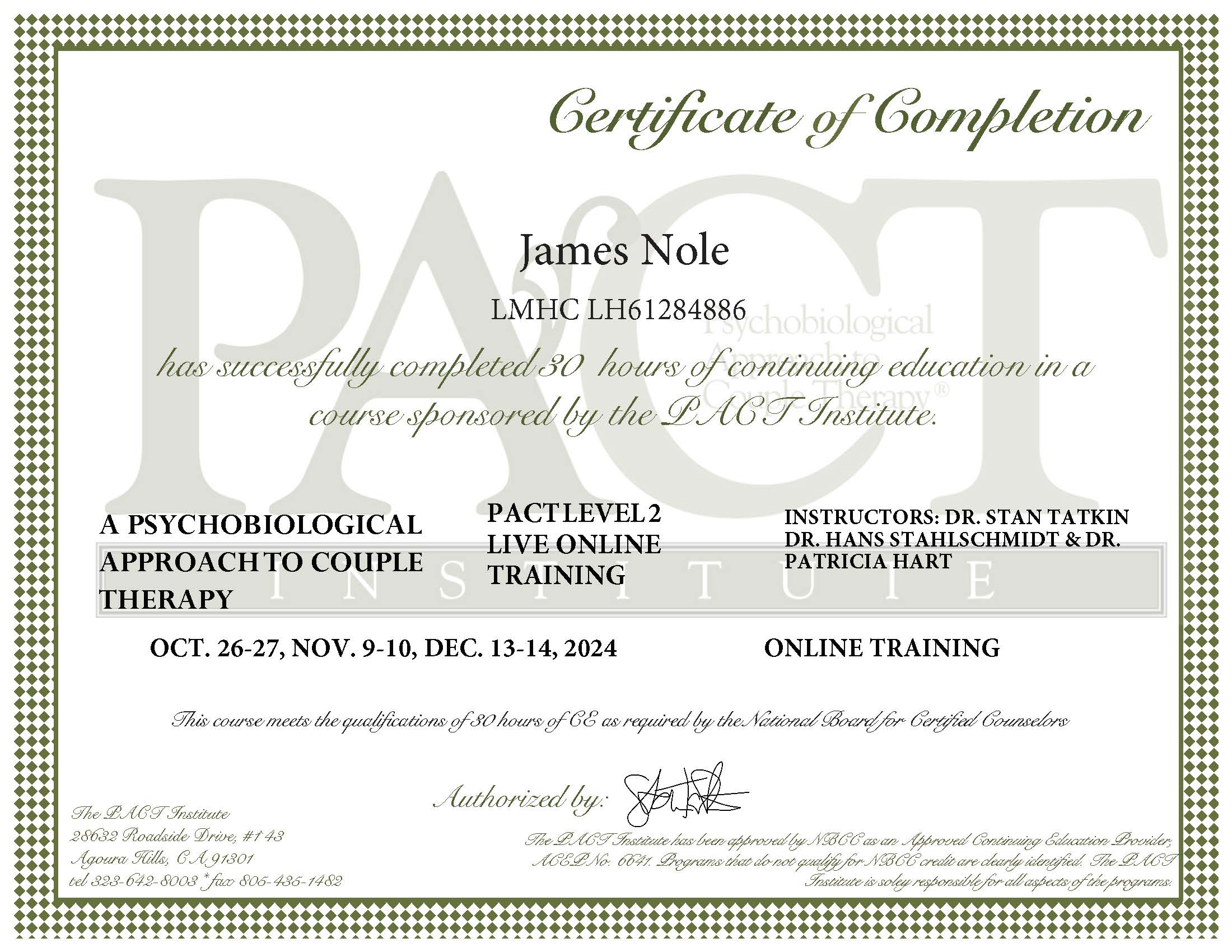
And from the PACT framework for couples work, when anxiety is reverberating through a relationship and each partner's nervous system is activating the other's, we bring that relational dimension into the room directly.
None of these approaches are applied as protocols. They are brought to bear with clinical judgment and genuine attentiveness to what each specific person needs. The therapy adapts to you, not the other way around.
What Anxiety Therapy Sessions Look Like With Me
Sessions focused on anxiety with me do not look like most people expect.
We do not begin with a symptom checklist or a hierarchy of fears to be systematically addressed. We begin with you, with what is present, with what you notice in your body right now, with what the anxiety has been doing and what it seems to be responding to.
I am as interested in what your anxiety is trying to say as I am in quieting it. That does not mean I am indifferent to the suffering it causes. It means I believe the suffering is pointing somewhere worth following, and that following it carefully, with curiosity rather than alarm, is what creates lasting change rather than temporary relief.
We will pay attention to the body throughout. Anxiety is a somatic experience as much as a cognitive one, and the body often knows things that the thinking mind has not yet caught up to. We will slow down enough to notice what is actually happening, in the chest, in the throat, in the way you are sitting and breathing and holding yourself, because that is where some of the most important material lives.
We will also listen for the parts. When a particular anxiety arises, I will often invite a quality of curiosity toward it rather than a reflexive attempt to manage or suppress it. What is this part carrying? What does it need? What has it been trying to communicate? That shift in orientation, from fighting the anxiety to genuinely listening to it, is often where the most significant movement begins.
And we will attend to the relational dimensions of your anxiety, what it does in your relationships, how it shows up between us in the room, because that relational dimension is often where the deepest roots are most directly accessible.
This is not a quick fix. I will not promise you that. But it is the kind of work that reaches the places that coping skills and breathing exercises alone have not been able to reach. And in my experience, that is the work that actually lasts.
Why I Work With Anxiety This Way
I came to understand anxiety from the inside before I understood it clinically.
Living with a progressive degenerative condition from childhood, facing losses that arrived without warning and without adequate support, navigating medical systems that were not honest with me, building a life inside circumstances I did not choose and could not control, all of this produced its own particular relationship with anxiety. With the vigilance that comes from having learned early that the ground can shift without notice. With the hyperarousal that is what the nervous system does when it has experienced real and repeated uncertainty. With the existential dimensions of anxiety that come from genuinely confronting mortality and the absence of guarantees.
I also came to understand, through my own healing and through my clinical training, that much of what I had been experiencing as anxiety was not a malfunction. It was communication. Parts of me that were carrying grief, fear, and unresolved experience that had not been given adequate space or hearing. When those parts were finally met, when their messages were genuinely received, something that had felt permanent began to shift.
That understanding lives in how I sit with people who are anxious. I am not trying to move you quickly toward calm. I am trying to help you understand what your anxiety knows, and to find a relationship with it, and with the parts of you that are speaking through it, that is yours and that actually holds.
Who This Page Is For
Depth-oriented anxiety therapy in Seattle may be what you have been looking for if any of the following feel true:
You have tried other approaches to anxiety and found that something was still missing, that the tools helped in the moment but did not change the underlying frequency. You sense that your anxiety has roots that have not been adequately explored, in your history, your relationships, your body, or in questions you have been avoiding. You have a felt sense that different parts of you want different things, that you are at war with yourself in some way you cannot fully articulate, and that the anxiety is somehow connected to that internal conflict. You live with anxiety that is woven into how you relate to other people, how you attach, how close you allow yourself to get before something in you pulls back. You experience anxiety that lives in the body rather than primarily in thoughts, a physical restlessness, tension, or dread that does not respond to cognitive reframing. You carry existential anxiety about mortality, meaning, or the life you are living, and you want a therapy that can meet those questions honestly rather than treating them as symptoms to be managed. You have been through experiences of loss, medical difficulty, or relational wounding that you believe are connected to the anxiety you carry now. You are looking for an approach that takes your anxiety seriously as a meaningful communication rather than a malfunction to be corrected.
You do not have to arrive with a clear diagnosis or a neat description of what your anxiety is. You can bring it exactly as it is.
Frequently Asked Questions
Is this approach evidence-based?
Yes. Each of the frameworks I draw on in anxiety work has an evidence base supporting its effectiveness. Psychodynamic approaches to anxiety have been validated in multiple studies and are associated with lasting change that continues after treatment ends. Ego state and parts work has a growing research base demonstrating its effectiveness for anxiety, trauma, and complex presentations. Deep Brain Reorienting has demonstrated significant results in randomized controlled trials. Clinical hypnosis has a robust and growing body of research supporting its effectiveness for anxiety and related conditions. The integrative approach I take is grounded in the research base of each component while applying them through clinical judgment rather than rigid protocol.
How is this different from CBT for anxiety?
CBT is a valuable and well-researched approach that works primarily at the level of thought patterns and behavioral responses. It tends to be structured, time-limited, and focused on symptom reduction. The depth-oriented integrative approach I use works at a different level, attending to the unconscious roots of anxiety, the parts of the self that are communicating through the symptoms, the body's held experience, and the relational and existential dimensions that CBT does not typically address. For people whose anxiety has not responded fully to CBT, or who sense that something deeper is driving it, this approach often reaches what CBT could not.
What do you mean by parts or ego states?
Ego state theory understands the inner life as a system of parts, each carrying its own history, feelings, and beliefs. In the context of anxiety, this means approaching each symptom with curiosity about which part of the self is communicating through it, what that part is carrying, and what it needs. Rather than treating anxiety as something to be eliminated, we treat it as a message from a part that deserves to be heard. When that part is genuinely met, the anxiety it has been expressing often shifts in ways that symptom management alone cannot produce.
What if my anxiety is related to trauma?
This is very common. Anxiety and trauma are deeply interconnected, and for many people the anxiety they experience is the nervous system's ongoing response to experiences of threat or overwhelming helplessness that were never fully processed. I specialize in trauma work and bring that specialization directly to bear in anxiety therapy, including through Deep Brain Reorienting, which works at the brainstem level where trauma-related anxiety is most deeply rooted.
How long does anxiety therapy take?
This depends significantly on the nature and roots of the anxiety. Some people experience meaningful shifts relatively quickly. Others, particularly those whose anxiety is rooted in complex relational histories or unprocessed trauma, find that deeper and more lasting change requires a longer engagement. We talk about this openly and regularly, and the pace and duration of the work are always something we determine together.
Do you offer anxiety therapy via telehealth?
Yes. I offer both in-person anxiety therapy sessions at my Pioneer Square office in Seattle and telehealth sessions for clients throughout Washington State.
Closing
If your anxiety has been trying to tell you something, and the approaches you have tried so far have not been able to hear it, I would encourage you to reach out.
A free 30-minute consultation is a no-pressure way to share what you have been carrying, ask questions about this approach, and get a sense of whether working together might be what you have been looking for.
Explore related: therapy for depression, trauma & complex PTSD therapy, and relational psychodynamic therapy.
Related reading: Anxiety; Self-Compassion; and Acceptance and Therapy.